
Playing the flute: Step 3
Switching octaves
On a flute, you can use the same fingering to produce a note one octave higher. Practice switching between two F notes that are an octave apart using the same fingering.
F |
|

NOTE
・ If you play the flute with the ASTFL attached, blow harder to produce a higher pitch, as if you were blowing out a candle, or blow more gently to produce a lower pitch.
・ If you want to play higher pitch notes without using the ASTFL, make your breath speed faster by narrowing the air passage.
・ To produce a lower pitch note, the direction of the air stream should be downward. To produce a higher pitch note, the direction of the air stream should be forward. Gradually tilt your chin slightly upwards while blowing harder to find a sweet spot that makes it easier to produce higher pitch notes.
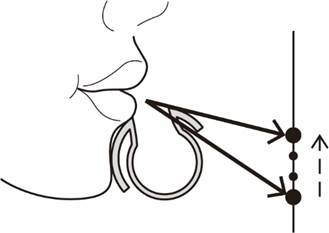
Playing higher G, F, E, D
Using the same fingering you used in step 1, try articulating higher G, F, and E notes. Start with a note that is easy to play, and then move on to higher or lower notes.
G |
|

F |
|

E |
|

To play a higher D, release the left index finger, press down with your right ring finger, and release your right little finger.
D |
|

Once you feel comfortable articulating each note, try playing four notes in a row.
Changing between higher D and higher C
When you change between higher D and higher C, you must switch the entire fingering. Practice so that transition between the notes is smooth.
D |
|

C |
|

HINT The stability of the instrument position varies depending on whether or not you use the ASTFL. Practice so that you will be able to hold the flute and keep it stable. If the base of the left index finger is not touching the instrument, the position of the instrument may become unstable. If this happens, review the “Holding the instrument” section. |