


Input channel I/O unit section
This section describes the I/O unit section for the input channels.
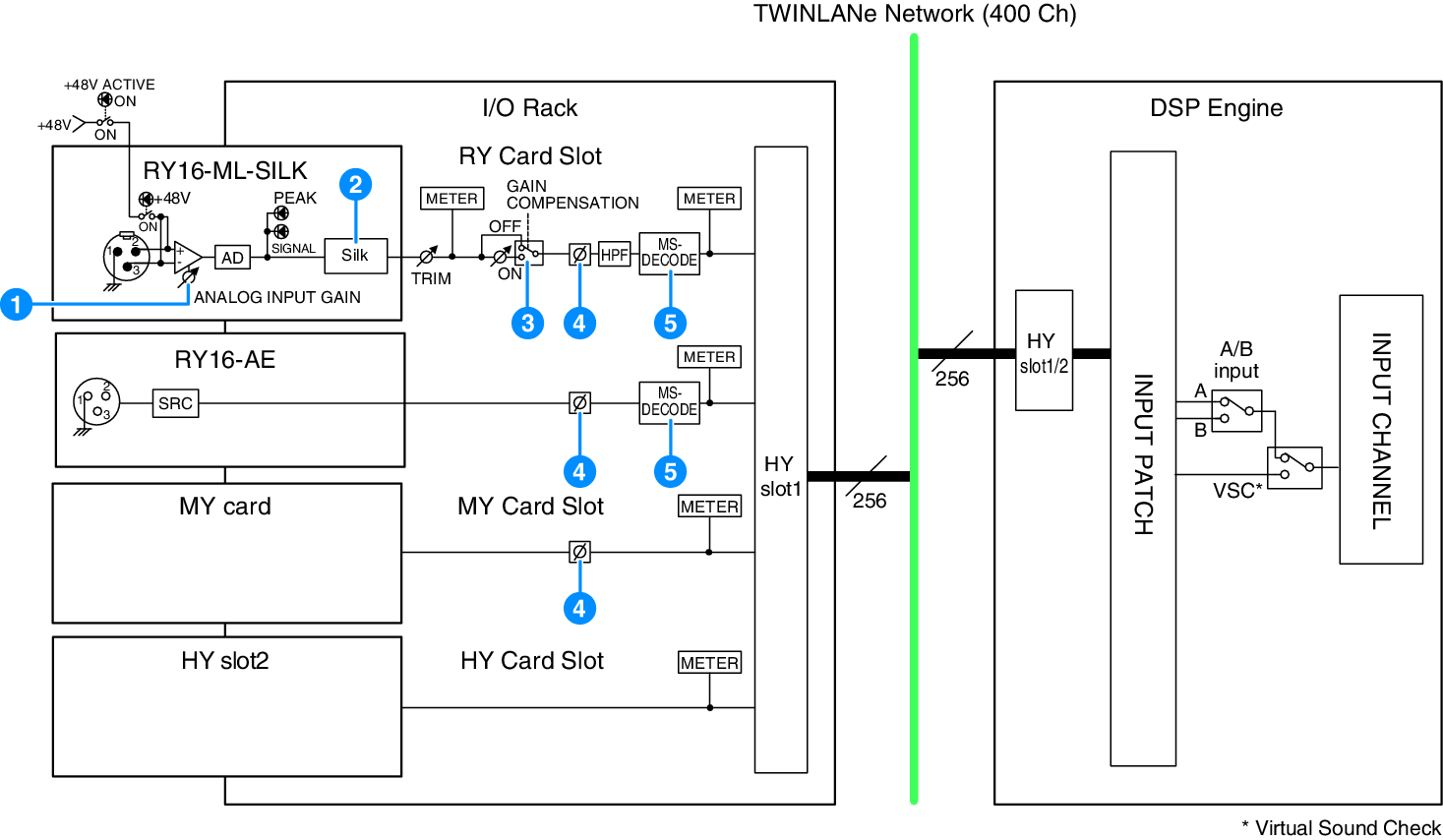
a | ANALOG INPUT GAIN This is the analog gain of the head amp. |
b | Silk (available only on the CS-R10, CS-R10-S, and CSD-R7) Allows you to add a natural sense of audio transformer compression and saturation. This enhances the sense of depth and space, freshening the sound. You can control the brilliance or power. |
Silk uses proprietary Yamaha “VCM technology” digital signal processing to faithfully replicate the “Silk” processing that is built into numerous high-end analog audio devices developed, manufactured, and sold by Rupert Neve Designs.
Based on the natural compression and saturation of audio transformers, a matter about which Rupert Neve is especially passionate, the user can choose one of two characters, “Blue” or “Red,” and use a continuously-variable “Texture” knob that allows effective control over the tone and the accompanying overtones.
Silk allows effects such as the following.
- In addition to adding power and brilliance, you can recover the sense of air that tends to be lost in the mix.
- The graceful and solid tone characteristic of an analog console can be obtained.
- Breathing and subtle pianissimos can be expressed in a lifelike way.
- Channel EQ and reverb become more effective.
- If this is used only on a small number of important channels, those parts will stand out from the mix.
- If this is used on all channels, the mix will be given depth and three-dimensional character.
- Red: Bright and lively
- Blue: Rich and powerful
This is a revolutionary mic preamp that uses digital signal processing to model and combine the ultra-high-quality analog mic preamp representing the pinnacle of Yamaha’s “natural sound” philosophy with Rupert Neve Designs’ “Silk” processing that allows you to freely control the sound’s “depth, space, and air.” In the RIVAGE PM series, Hybrid Mic Preamp as standard on the RY16-ML-SILK and on all the OMNI INPUT channels on the rear panel of the control surface.
c | GAIN COMPENSATION Switches the gain compensation on or off for that channel. If this is on, the signal level that is output from the I/O rack to the audio network remains constant even if the HA analog gain is adjusted. |
The HA analog gain of the I/O rack can be controlled by the gain knob of the control surface, but normally this will also change the input level to another DSP engine or recording device that shares the input.
However if gain compensation is used to fix the gain within the I/O rack, the signal level that is output to the audio network is kept constant. In other words, raising (or lowering) the analog gain causes the compensation gain within the I/O rack to decrease (or increase). Because the mixing input level can be operated using the digital gain within the DSP engine, this allows the input level to be optimal for various routes used for different purposes.
Even if you turn gain compensation off again, the analog gain and compensation gain will return to the settings they had when gain compensation was turned on, so the signal level that is output to the audio network will not change.
In this way, you can adjust the analog gain for the optimal S/N ratio and use the digital gain to adjust the input level independently.
d | Ø Reverses the phase of the input signal. |
e | M/S DECODE An M/S decoder is built in. The M/S decoder is provided for adjacent odd- and even-numbered channels. |
 RIVAGE PM Series